


Introduction
You're walking through the park with your toddler when a fluffy golden retriever trots by. You point and say, "Look, a doggy!" Your child's eyes follow your finger, lock onto the dog, then glance back at you with a smile. That tiny exchange, two people sharing focus on the same thing, is joint attention, and it's one of the most powerful predictors of a child's social and language development.
For families in Texas navigating an autism diagnosis, understanding joint attention can change everything about how you connect with your child.
What Is Joint Attention?
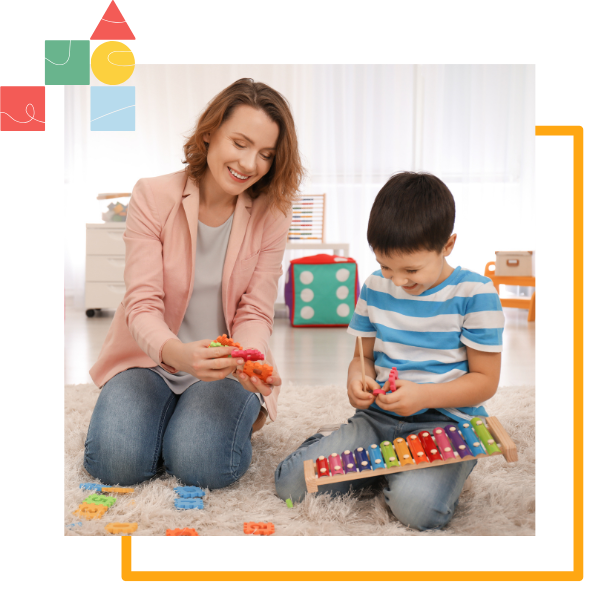
Joint attention is the shared focus between two people on the same object, person, or event.
It usually develops between 9 and 18 months and shows up in three ways:
- Responding to joint attention — your child looks where you point or gaze
- Initiating joint attention — your child points, shows, or looks at you to share something interesting
- Coordinated attention — your child shifts their gaze between you and the object to make sure you're "in on it."
It sounds simple, but joint attention is the foundation for language, learning, play, and emotional connection. When a child notices a butterfly and looks back at Mom to share the moment, they're learning that experiences are better when shared, and that's the seed of social communication.
Why Joint Attention Matters in Autism
A joint attention deficit in autism is one of the earliest red flags pediatricians and developmental specialists look for. Many children with Autism Spectrum Disorder (ASD) don't naturally engage in this back-and-forth sharing. They may not follow a point, respond to their name, or look up to share excitement.
This isn't a behavior problem. It's a developmental difference. And without intervention, gaps in joint attention can ripple into delays in speech, play skills, and peer relationships.
The good news? Joint attention can absolutely be taught.
How ABA Therapy Teaches Joint Attention
At Steady Strides ABA, joint attention is one of the first skills we target during early intervention across our
home-based,
center-based, and
school-based programs throughout Texas. Using joint attention
ABA therapy techniques, our BCBAs break the skill into small, teachable steps.
In our sessions, we've seen children move from no eye contact at all to spontaneously pointing at airplanes within a few months. Here's how to teach joint attention in everyday moments:
- Follow your child's lead. Comment on whatever they're already looking at.
- Use exaggerated gestures. Big points, wide eyes, and animated voices make sharing irresistible.
- Pause and wait. Hold a favorite toy near your eyes and wait for your child to look at you before handing it over.
- Reinforce every glance. Smiles, tickles, or "You saw it!" turn shared looks into rewarding moments.
Our ABA Parent Training program teaches Texas families to weave these strategies into bath time, snack time, and trips to H-E-B, because joint attention grows fastest when it's practiced all day, not just in therapy.
Conclusion
Joint attention is more than a milestone. It's the bridge to language, friendships, and a lifetime of shared moments. If you're noticing gaps in your child's ability to share attention, you're not alone, and you're not too late.
Steady Strides ABA offers autism assessments, early intervention, and family-centered ABA therapy in Texas to help your child build this essential skill, one shared smile at a time.
Ready to take the next step? Reach us out today!
Frequently Asked Questions
At what age should joint attention develop in children?
Most children begin showing joint attention between 9 and 12 months, with consistent pointing and gaze-shifting by 18 months. If your child isn't showing these behaviors by their first birthday, talk to your pediatrician about an autism evaluation.
Can joint attention be taught to a child with autism?
Yes. Decades of research and our own clinical experience show that joint attention is a teachable skill. ABA therapy, especially when started early, helps children learn to respond to and initiate shared attention through structured, play-based teaching.
What does a joint attention deficit look like in toddlers?
Common signs include not responding to their name, not following a point, not showing toys to caregivers, limited eye contact, and not looking back at a parent to share excitement about something interesting.
SOURCES:
https://www.med.unc.edu/healthsciences/asap/materials-1/about-joint-attention/
https://pmc.ncbi.nlm.nih.gov/articles/PMC1693124/
https://www.mcrorypediatrics.com/post/joint-attention-in-autism-why-it-matters-and-how-to-support-it-at-home
https://www.autismparentingmagazine.com/joint-attention-autism/?srsltid=AfmBOoricc8mn_8cQvBTUMbtY3kCvqHlRAm5oDPNmIk-NMs-gz1eKJ3s
https://onlinelibrary.wiley.com/doi/full/10.1002/aur.2600